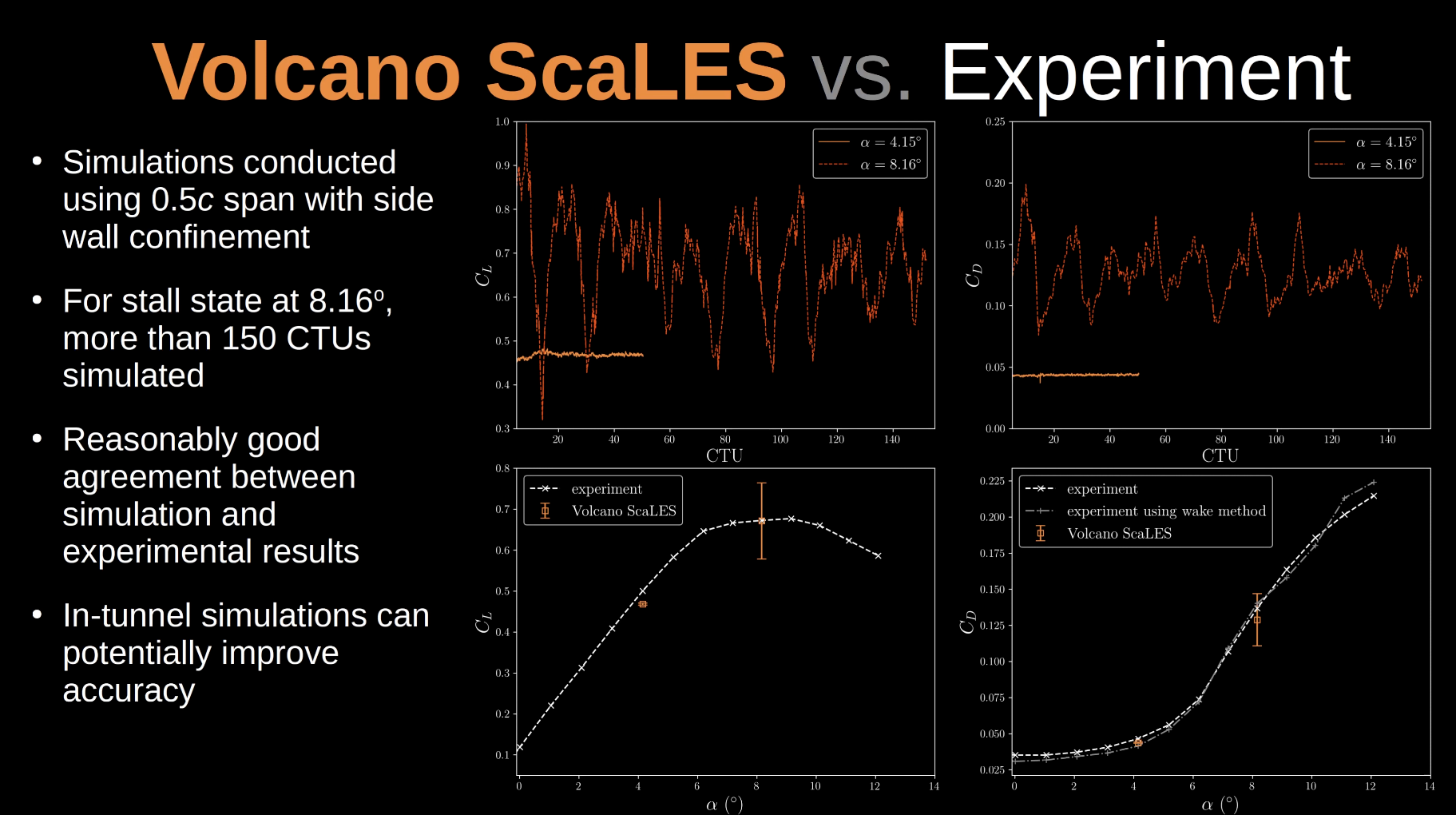
Understanding the effects of ice accretion on aerodynamic devices is important for the design and development of an aircraft. When a wing is contaminated with ice, its aerodynamic performance is significantly degraded due to flow separation triggered by the ice attached at the leading edge and this leads to concerns of flight safety. Accurate predictions of the impact of ice accretion on the aerodynamic characteristics, such as the maximum lift coefficient, stall angle of attack, and the drag coefficient, etc, using computational methods can speed up and reduce the cost of the design, development, and certification of aircraft under the icing conditions.
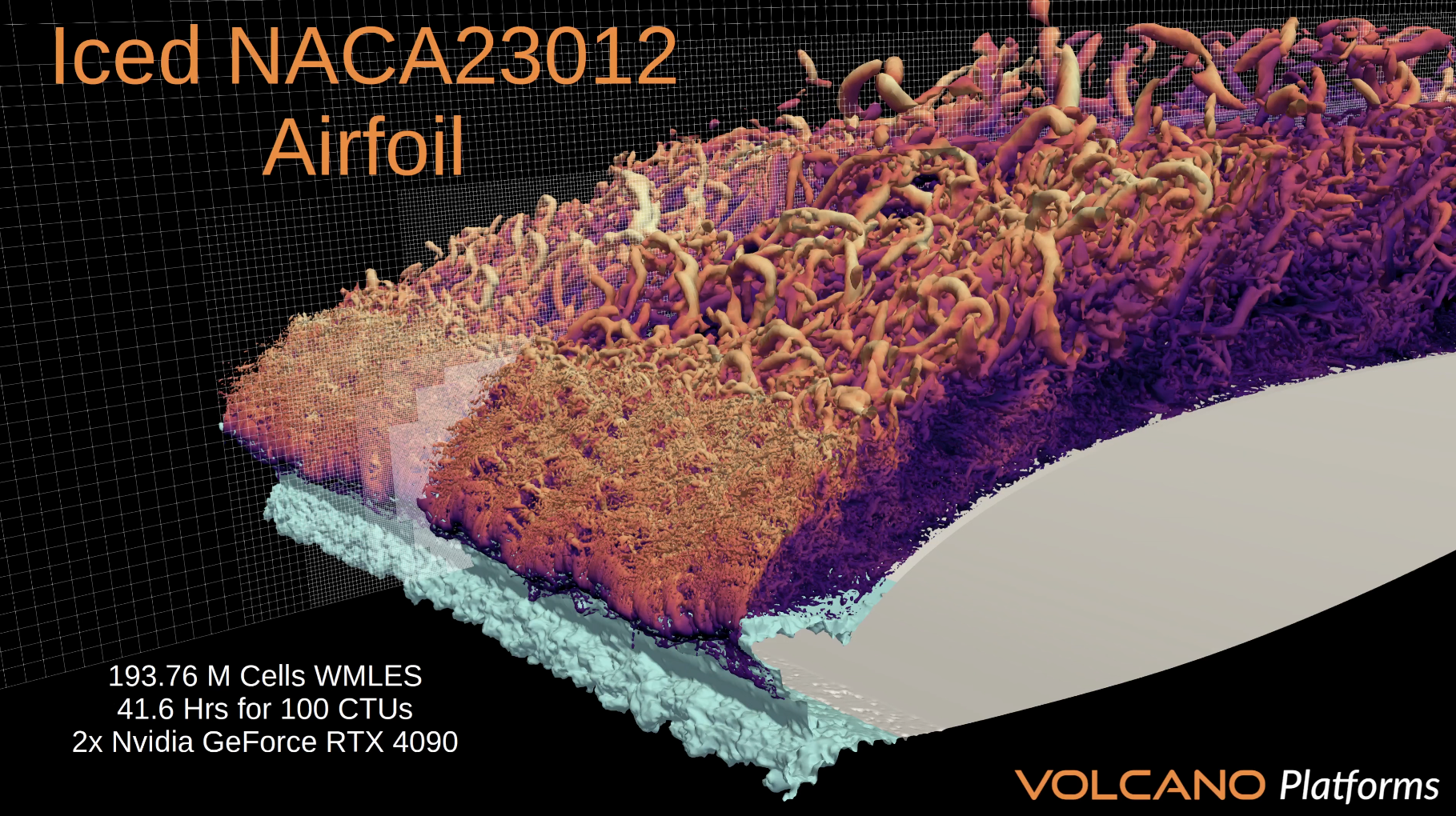
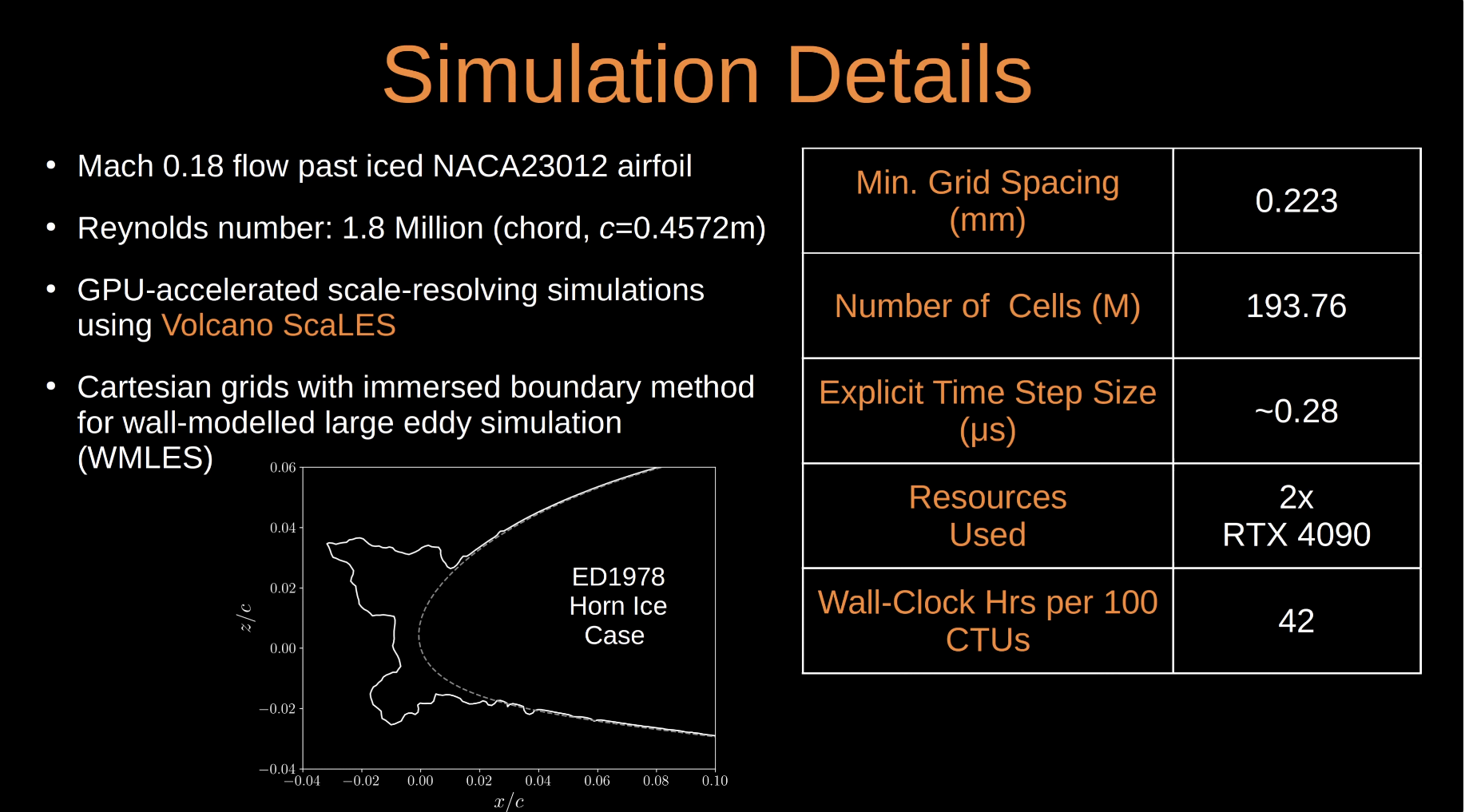
A newly developed compressible Navier–Stokes solver based on octree Cartesian grids, Volcano ScaLES, is used for Wall-Modelled Large Eddy Simulations (WMLES) of the flow around the NACA23012 airfoil with the horn ice accretion. The video shows a simulation with 194 million cells performed in less than two days (100 CTUs) on a desktop computer containing just two Nvidia RTX 4090 GPUs with 24 Gb of memory each. This represents a major breakthrough in LES utilization for aerodynamics making “supercomputer-class” calculations routine on readily available resources. Automated, predictive, and cost-effective simulation capability is critical to provide the vast amount of data needed to train AI/ML models for engineering decisions.