Aerodynamic flows for realistic road vehicles exhibit several complex flow phenomena typical of bluff body flows at high Reynolds numbers. Off-body vorticity with large regions of turbulent recirculation in the wake, boundary layer separation and reattachment, near ground boundary layer interaction, and laminar-to-turbulent transition that can be delicately affected by the local curvature of the vehicle exterior to name a few. Previous AutoCFD workshops along with the 4th edition (AutoCFD-4) currently underway have demonstrated the need for scale-resolving simulations to accurately model this highly complex flow.
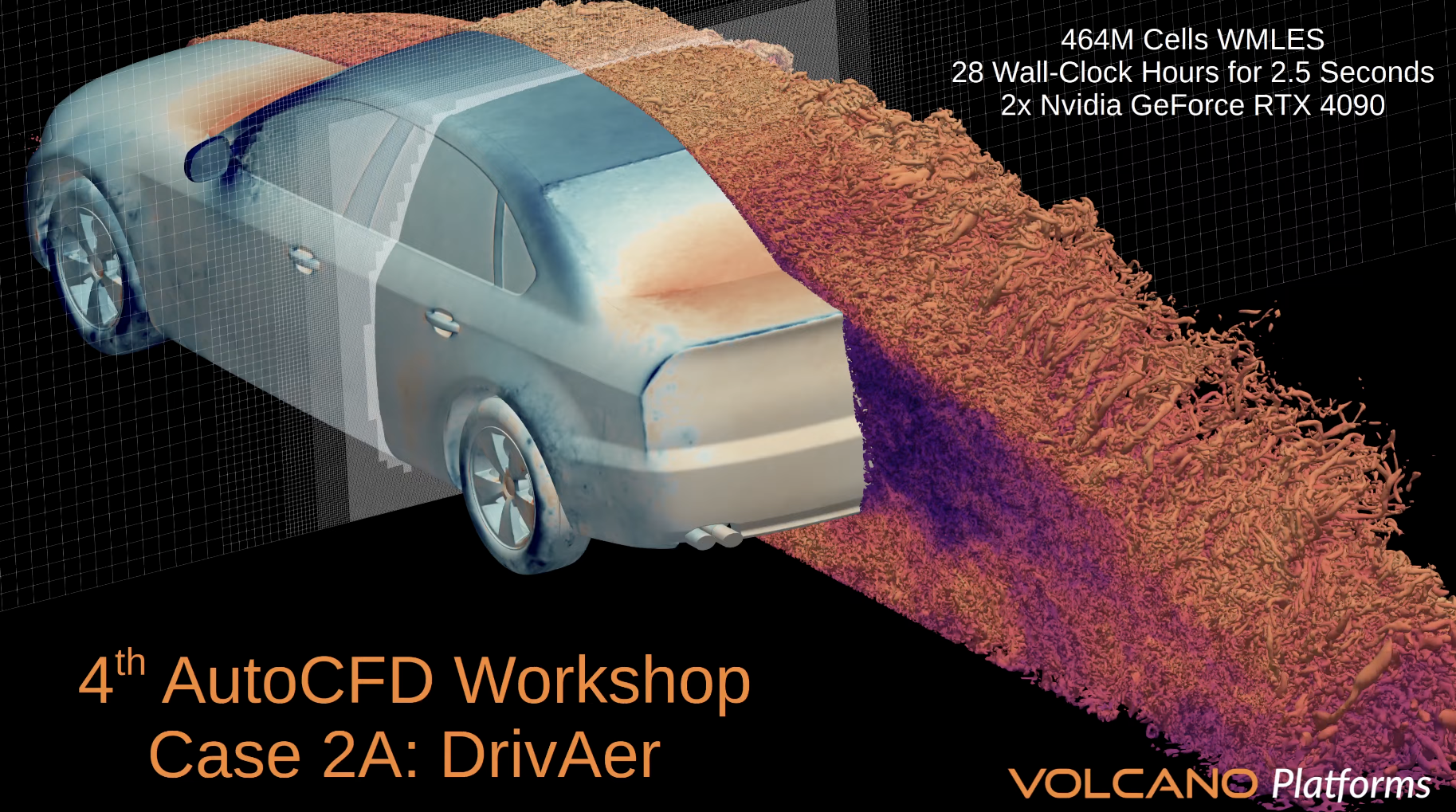
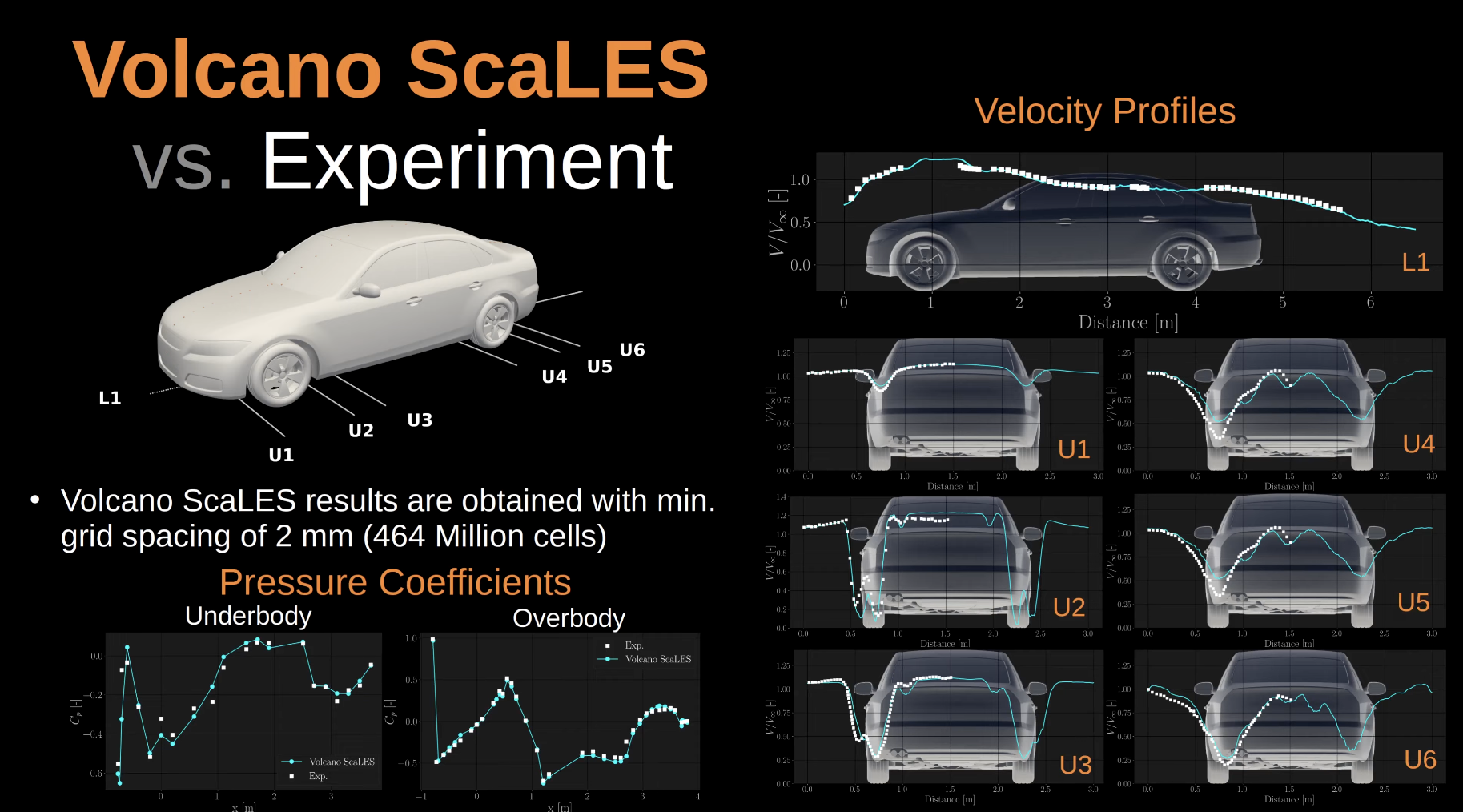
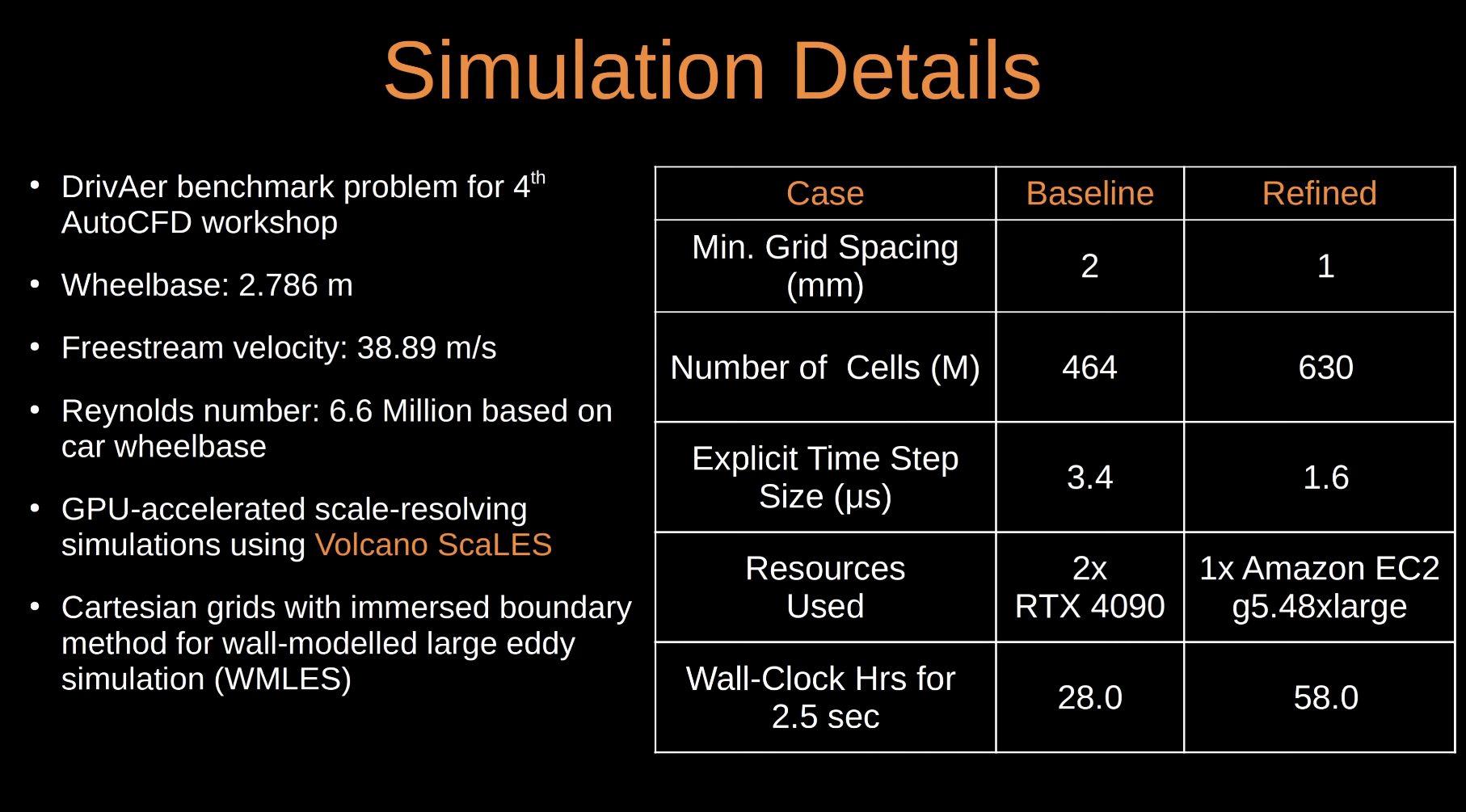
A newly developed compressible Navier–Stokes solver based on octree Cartesian grids, Volcano ScaLES, is used for Wall-Modelled Large Eddy Simulations (WMLES) of the AutoCFD-4 Test Case 2a, DrivAer model. The video shows a 3D simulation with 464 million cells performed in about one day on a desktop computer containing just two Nvidia RTX 4090 GPUs with 24 Gb of memory each. Total simulation time was approximately 2.5 seconds of physical time. With collaboration with Dr. @Neil Ashton of AWS, a second finer simulation with 630 million cells was run on one Amazon EC2 g5.48xlarge (8x Nvidia 10g) node in less than 2.5 days.
This represents a major breakthrough in LES utilization for automobile CFD making “supercomputer-class” calculations routine on readily available resources. Automated, predictive, and cost-effective simulation capability is critical to provide the vast amount of data needed to train AI/ML models for engineering decisions.