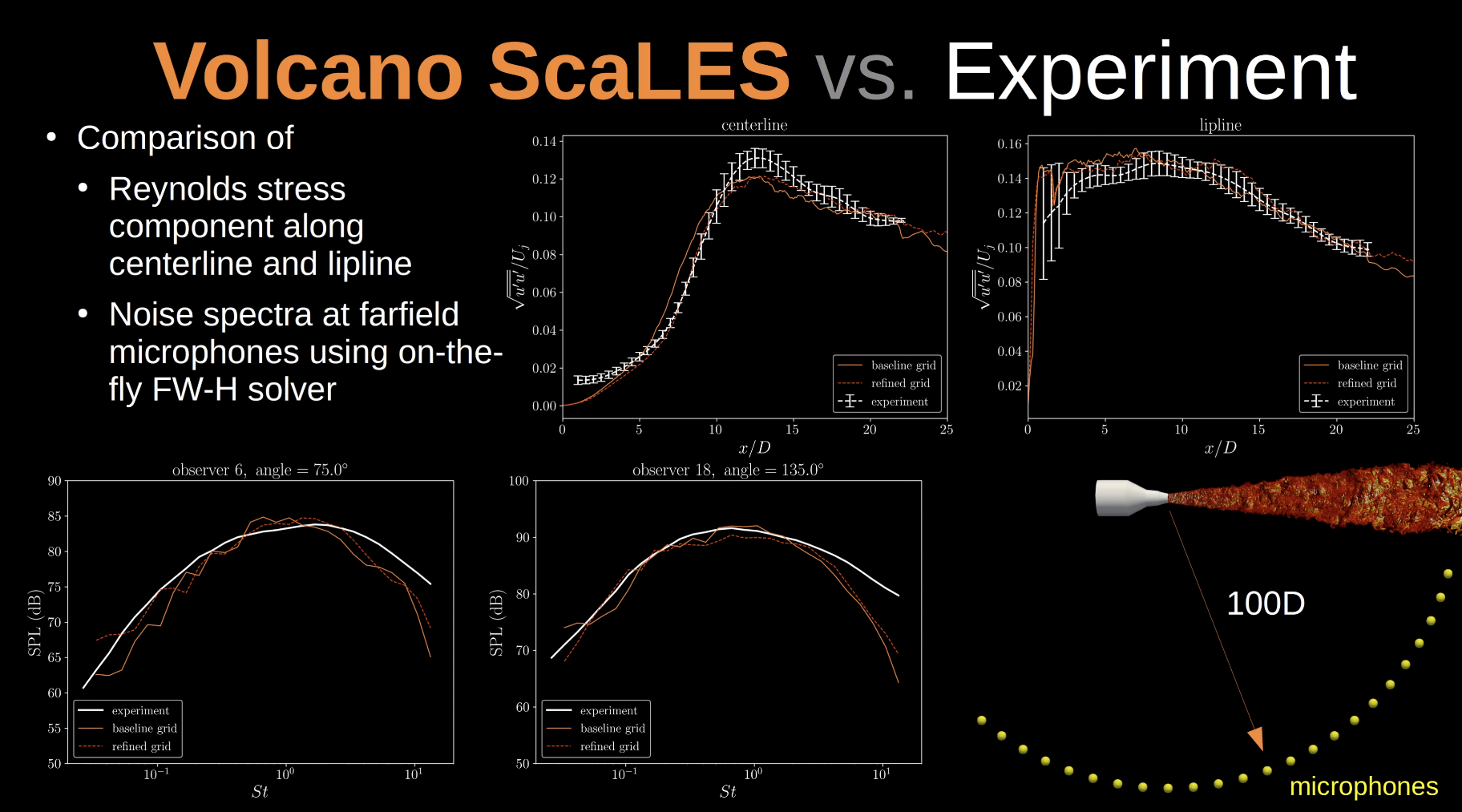
Aircraft noise has detrimental effects on the public health near airports. While there have been continuous progress in the reduction of propulsion noise of civil aircrafts, propulsive jet noise still dominates the overall civil aircraft noise during takeoff and flyover conditions. To improve the design of quieter engines, there is an increasing demand on the use of Computational Fluid Dynamics (CFD) and Computational Aero-Acoustics (CAA) tools for accurate predictions of jet aeroacoustics. Large Eddy Simulations (LES) provide a computationally feasible way for acoustic predictions by resolving the wide range of turbulent scales generated from the mixing between jet plume and ambient gas.
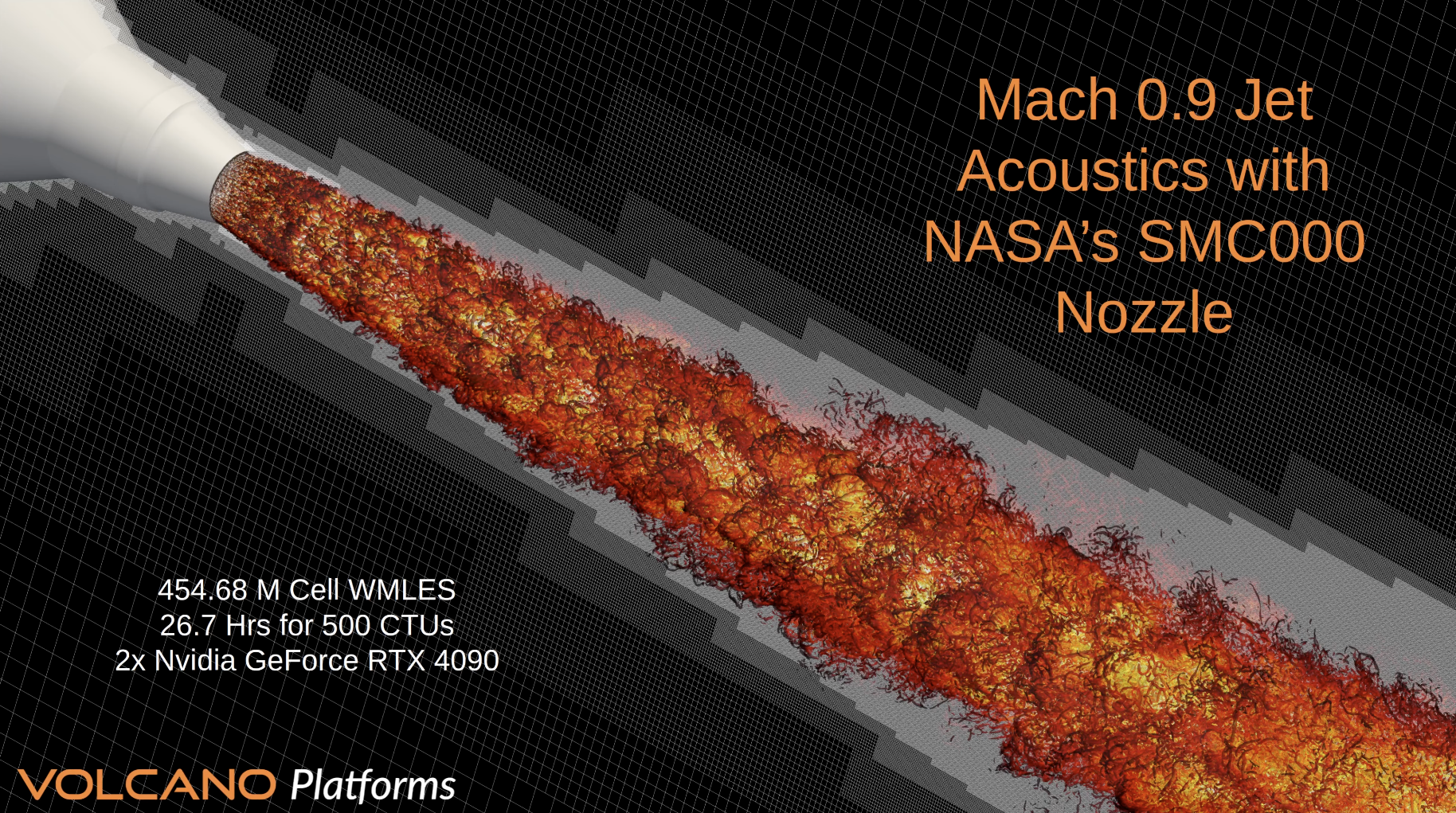
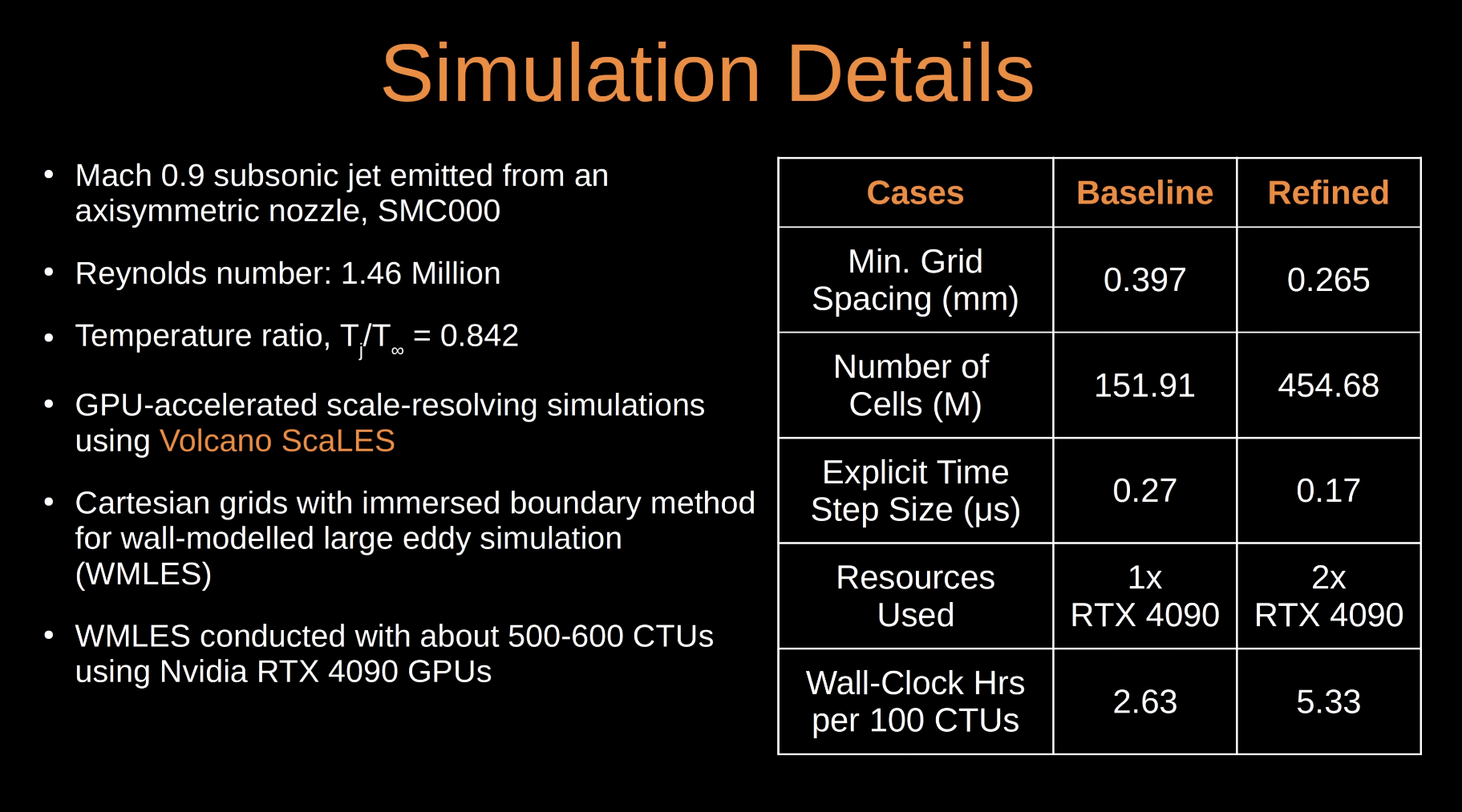
A newly developed compressible Navier–Stokes solver based on octree Cartesian grids, Volcano ScaLES, is used for LES of subsonic turbulent jet flows. The video shows a simulation with 450 million cells performed in one day on a desktop computer containing just two Nvidia RTX 4090 GPUs with 24 Gb of memory each. This represents a major breakthrough in LES utilization for jet acoustics making “supercomputer-class” calculations routine on readily available resources. Automated, predictive, and cost-effective simulation capability is critical to provide the vast amount of data needed to train AI/ML models for engineering decisions.