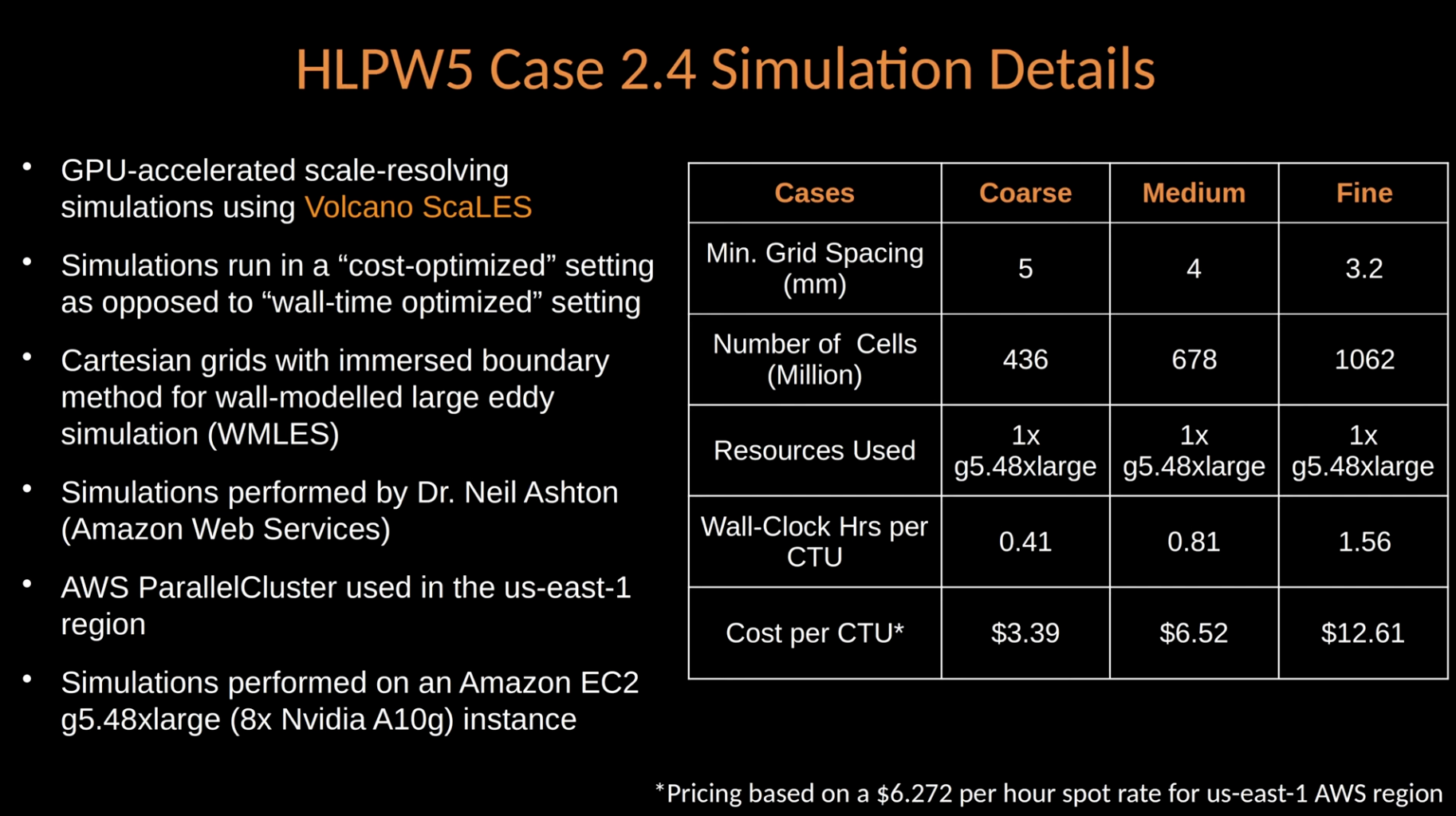
Accurate prediction of high-lift aerodynamics on conventional aircraft is notoriously challenging. The flowfield is dominated by the strong interplay between turbulent boundary layer flow separation, off-body vortex tubes and complex wake-boundary layer mergers. This problem has been the focus of four past AIAA High-Lift Prediction Workshops (HLPW), and the large scatter seen in submissions over the years underscores the need for rapid advancement and rigorous evaluation of new technologies such as Wall-Modelled Large Eddy Simulation in order to facilitate analysis-based compliance for aircraft certification.
A newly developed compressible Navier–Stokes solver based on octree Cartesian grids, Volcano ScaLES, is used for Wall-Modelled Large Eddy Simulations (WMLES) of the HLPW5 Test Cases 2.2, 2.3, and 2.4. The video shows a simulation performed by Dr. Neil Ashton of AWS on a billion cell mesh. Simulating 7 seconds (approx. 70CTUs) of flow on one Amazon EC2 g5.48xlarge (8x Nvidia A10g) node costs approximately $880 which is comparable to typical cost of a steady-state RANS simulations. This represents a major breakthrough in LES utilization for high-lift aerodynamics making “supercomputer-class” calculations routine on readily available resources. Automated, predictive, and cost-effective simulation capability is critical to provide the vast amount of data needed to train AI/ML models for engineering decisions.